
Intelerad vs Ambra Health vs UltraLinq vs Medicai for Cloud-Based Medical Imaging Solutions
Most hospitals and radiology groups face a four-way decision when their current PACS vendor limits image access outside one network. The choice between Intelerad, Ambra Health, UltraLinq, and Medicai now determines whether referring doctors get instant access or continue waiting for discs and links. Each platform promises different trade-offs in speed, security, and total cost.
This article walks through the key differences in sharing features, compliance controls, and pricing so you can match the right option to your network size and referral patterns. By the end, you will see which platform fits your volume of outside studies and your need for zero-footprint viewing.
Quick Verdict: Intelerad vs Ambra Health vs UltraLinq vs Medicai for Cloud-Based Medical Imaging Solutions
Intelerad, Ambra Health, UltraLinq, and Medicai each provide cloud-based medical imaging platforms with distinct strengths in workflow, compliance, and collaboration.
Intelerad stands out for its scale in large hospital systems. Ambra Health focuses on ease of referring-physician access. UltraLinq centers on cardiology focus. Medicai processes 1M+ studies per year plus 50M+ yearly API transactions.
Intelerad works well for enterprise hospitals that need broad multi-site deployment. Ambra Health appeals to practices that prioritize simple image sharing with external referrers. UltraLinq serves cardiology departments that require specialized cardiac imaging tools.
Medicai supports 70 clinics and hospitals with 10,000+ active doctors on the platform. The system maintains HIPAA and GDPR compliance while following OWASP security guidelines. It offers 1.7M+ studies in storage and 300k+ visualizations of DICOM studies in the last year.
Intelerad works best for health systems managing multiple facilities across regions. Ambra Health fits practices that need quick external physician connections. UltraLinq serves cardiology centers focused on heart imaging workflows.
Medicai reduces diagnosis time by 65% for teams that handle high study volumes. The platform supports Ukrainian refugee patients in accessing cancer treatments through global multidisciplinary tumor boards. It partners with Microsoft Azure for reliable cloud infrastructure.
At a glance: how Medicai compares to Intelerad, Ambra Health, UltraLinq, Medicai for Cloud-Based Medical Imaging Solutions on the features that matter most.
| Feature | Medicai | Intelerad | Ambra Health | UltraLinq | Medicai for Cloud-Based Medical Imaging Solutions |
|---|---|---|---|---|---|
| Cloud-Based Medical Imaging Solutions | ✓ | ✓ | ✓ | ✓ | ✓ |
What Is Medicai?
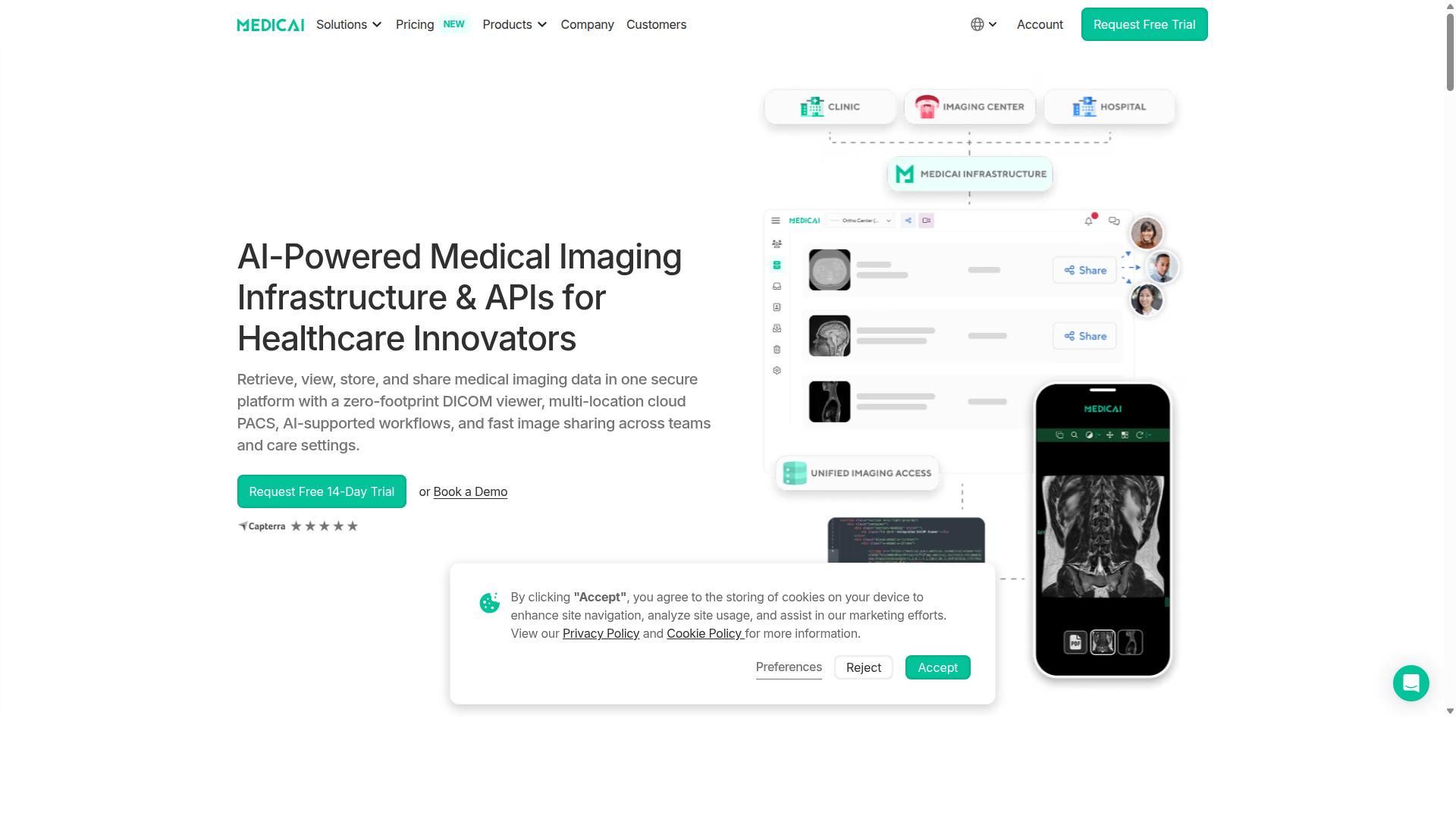
Medicai is a cloud-based medical imaging platform that enables healthcare providers to retrieve, view, store, and share DICOM studies through a zero-footprint viewer. The platform combines multiple core functions that support modern radiology workflow needs across different care settings. These integrated capabilities help organizations manage imaging data without separate systems for each task. Our breakdown of MRI Right Knee Without Contrast CPT Code: 73721 Guide covers the related details.
The uploader function allows medical facilities to send studies directly into the cloud storage system. A DICOM gateway connects existing imaging equipment to the platform, while the Cloud PACS handles viewing and distribution across multiple locations. These components work together to reduce the complexity of managing diagnostic imaging equipment from different vendors.
The VNA component serves as a vendor neutral archive that stores medical images in standard formats. Patient-case management tools organize studies by case rather than by individual image files. This approach supports coordinated care when multiple specialists need access to the same imaging data.
Storage options begin with the 500 GB Starter tier for smaller practices and expand to the 2 TB Standard tier for larger facilities. The platform maintains HIPAA, GDPR, FDA, and CEE clearances for compliance across different regulatory environments. Current scale includes 1.7M+ studies in storage with 300k+ visualizations completed last year.
The Competitors at a Glance
Intelerad, Ambra Health, and UltraLinq are established cloud PACS vendors that differ in target specialties, deployment models, and integration depth. Each platform addresses distinct segments of the medical imaging market, ranging from large hospital networks to specialty practices.
These solutions share common goals around secure image management and remote access. The differences emerge in their approach to workflow consolidation, physician collaboration, and specialty-specific tools.
Understanding these distinctions helps radiology teams evaluate which platform aligns with their operational needs and growth trajectory.
What Is Intelerad?
Intelerad is an enterprise-grade PACS and workflow platform commonly deployed in large hospital systems and multi-site radiology groups. The solution consolidates RIS and PACS functions into a single environment that supports high-volume imaging operations.
Key capabilities include AI-assisted routing that directs studies to appropriate radiologists based on subspecialty expertise. HL7 and FHIR support enables integration with existing hospital information systems and electronic health records.
The platform accommodates CT, MRI, ultrasound, X-ray, nuclear medicine, and mammography workflows. Multi-site deployment features allow centralized administration across geographically dispersed facilities while maintaining local performance requirements.
What Is Ambra Health?
Ambra Health offers a cloud platform primarily focused on image exchange between hospitals and referring physicians. The solution emphasizes accessibility for external providers who need to view studies without installing specialized software.
A patient portal component allows individuals to access their imaging records directly. Automated routing features direct incoming studies to the appropriate destination based on predefined rules and recipient preferences.
The platform supports secure transmission of DICOM studies across organizational boundaries. This focus on interoperability makes the solution attractive for facilities that prioritize referring physician access and patient engagement features.
What Is UltraLinq?
UltraLinq is a cloud echocardiography and cardiology imaging solution used by private practices and hospital cardiology departments. The platform provides specialized measurement tools tailored to cardiac imaging workflows and reporting requirements.
Structured reporting capabilities capture quantitative data from ultrasound studies in standardized formats. The solution addresses the unique needs of cardiology practices that require precise measurement tracking and longitudinal comparison capabilities.
Integration with cardiology-specific modalities and reporting systems supports the clinical documentation needs of cardiovascular teams. The narrow specialty focus distinguishes this platform from broader radiology solutions that serve multiple imaging departments.
What Is Medicai for Cloud-Based Medical Imaging Solutions?
Medicai combines a zero-footprint DICOM viewer with Cloud PACS, VNA, automated study upload, and FHIR API endpoints in a single HIPAA-compliant workspace. This unified approach sets it apart from traditional solutions that often require multiple vendors. Organizations gain access to medical imaging tools without juggling separate systems.
The platform handles study upload through its Medical Imaging Uploader and DICOM Gateway. These tools connect imaging modalities directly to the cloud environment. They support CT, MRI, ultrasound, X-ray, nuclear medicine, and mammography workflows through standard modality integration.
Storage and management features include Cloud PACS, Medical Image Exchange, Patient Case Management, Vendor Neutral Archive, and Backup and Disaster Recovery. This architecture supports multi-site deployment while maintaining data consistency across locations. The VNA component ensures long-term image archiving that meets enterprise imaging requirements.
Access and collaboration tools encompass Structured Reporting for Radiology, Doctor Imaging Portal, Patient Imaging Portal, DICOM Viewer, and Medicai Imaging API. The Mobile Imaging App extends functionality beyond desktop environments. These capabilities support teleradiology operations and referring physician access without requiring additional software installations.
Medicai processes over 1M annual studies and handles more than 50M API transactions. This volume demonstrates real-world scalability across diverse healthcare settings. The Radiology AI Co-Pilot and AI-Powered Diagnostics features provide AI-assisted diagnosis capabilities within the same workspace.
Features Compared
The following two sections examine image-sharing workflows and the security/compliance frameworks each vendor claims to support.
Cloud-based medical imaging requires reliable tools for both secure data exchange and regulatory compliance. Each platform offers distinct approaches to these core needs, which affects how radiology departments and clinics manage daily operations.
Understanding these differences helps healthcare organizations select systems that align with their specific workflow demands and compliance requirements.
Image Sharing and Collaboration Capabilities
Each platform enables study sharing, but they differ in how referring physicians and patients gain access.
External user access varies across the four vendors. Some systems require dedicated accounts or software installation, while others provide simpler browser-based entry points for occasional users who need to review studies.
Zero-footprint viewers eliminate the need for local software downloads. This approach streamlines access for physicians working across multiple facilities or using different devices throughout the day.
Secure-link expiration controls allow administrators to set time limits on shared studies. This feature helps maintain data security while still enabling necessary collaboration between care teams.
Patient-portal options differ in complexity and branding. Ambra Health provides branded portals that healthcare organizations can customize, while Medicai supports straightforward one-click share links for quick distribution to patients or external providers.
These access methods affect both user adoption rates and the overall efficiency of radiology workflows in multi-provider settings.
Security, Compliance, and Scalability
All four vendors state HIPAA compliance; differences appear in additional certifications, encryption scope, and multi-site scalability.
Compliance certifications extend beyond basic HIPAA requirements for some platforms. Medicai maintains HIPAA, GDPR, FDA, and CEE clearances, providing additional regulatory coverage for organizations operating across different jurisdictions.
Data-residency options allow healthcare systems to select storage locations based on regulatory or operational needs. Encryption standards typically cover both data at rest and during transmission across these platforms.
Audit-log granularity determines how thoroughly access and modification events are tracked. More detailed logs support compliance reporting and security investigations when required.
| Vendor | Storage Tiers | Connected Locations | Compliance Scope |
|---|---|---|---|
| Medicai | Starter: 500 GB, Standard: 2 TB, Enterprise: Custom | Starter: None, Standard: One, Enterprise: Multiple | HIPAA, GDPR, FDA, CEE |
| Intelerad | General enterprise scaling | Multi-site support available | HIPAA stated |
| Ambra Health | General enterprise scaling | Multi-site support available | HIPAA stated |
| UltraLinq | General enterprise scaling | Multi-site support available | HIPAA stated |
Medicai's tiered approach provides clear storage and connectivity options. The Starter plan at $249 monthly includes 500 GB storage with unlimited user accounts, while the Standard plan at $749 monthly adds 2 TB storage and one connected location.
Enterprise customers can access custom storage configurations and multiple connected locations. A one-time DICOM Gateway setup fee of $1,000 applies per location for organizations requiring on-premises connections.
These documented options help organizations match platform capabilities with their current infrastructure needs and growth projections.
Pricing Compared
Transparent pricing is rare in this category; Medicai publishes two subscription tiers while the others typically quote per study or per site.
Most cloud PACS vendors keep their costs hidden behind sales calls, which makes budgeting difficult for radiology departments. This lack of visibility often leads to surprise fees for storage overages or additional locations.
Medicai stands out by listing clear monthly rates for its Starter and Standard plans. These published tiers eliminate guesswork when planning radiology workflow expenses.
Starter subscribers receive 500 GB Cloud Storage and unlimited user accounts for $249 per month. The plan does not include any connected locations, which suits smaller practices with straightforward image archiving needs.
Standard subscribers gain 2 TB Cloud Storage and a single connected location for $749 per month. This tier supports growing diagnostic imaging operations that require one external site integration.
Enterprise customers work with custom pricing that scales storage and supports multiple connected locations. Per-study pricing is also available for high-volume teleradiology workflows.
Yearly billing offers 15 percent savings on both Starter and Standard plans. Organizations pay $209 monthly for Starter and $639 monthly for Standard when committing annually.
Intelerad, Ambra Health, and UltraLinq keep their rates private. Each vendor requires direct consultation to receive pricing for cloud PACS features, storage limits, and multi-site deployment options.
A DICOM Gateway setup carries a one-time fee of $1,000 per location. This charge applies when organizations need to connect imaging modalities to the platform.
| Plan | Medicai Monthly Cost | Storage | Connected Locations | Competitors |
|---|---|---|---|---|
| Starter | $249 | 500 GB | None | Custom quote |
| Standard | $749 | 2 TB | One | Custom quote |
| Enterprise | Custom | Custom | Multiple | Custom quote |
Medicai also provides a 14-day trial of Starter plan features with no credit card required. This trial period allows teams to test medical imaging workflows before committing to a subscription.
Refunds are not available for partial periods, so organizations should evaluate the platform thoroughly during the trial window. This policy encourages careful planning before selecting a cloud storage solution for enterprise imaging needs.
Who Should Choose Medicai
Medicai's subscription tiers and API-first architecture suit mid-size health systems and specialty groups that need rapid external image exchange without heavy IT overhead.
Multi-site teleradiology becomes straightforward when different facilities share the same cloud environment. Hospitals and imaging centers can route studies between locations without manual transfer steps.
Specialty providers gain from direct integration with existing workflows. Orthopedics, neurology, oncology, cardiology, and ophthalmology teams can review studies across departments without new hardware.
AI-assisted workflows fit naturally inside the platform. Referring physicians access images through secure links while radiologists maintain diagnostic tools in one workspace.
Patient case management extends beyond internal teams. Tumor boards, clinical trials, and medical education groups can share complete imaging records with external collaborators.
Virtual care providers and telemedicine platforms benefit from the patient portal. Patients receive controlled access to their own studies without extra logins or software installations.
Personal injury lawyers and OB-GYN practices handle high volumes of outside studies. Zero-footprint viewer access lets them review images on standard browsers without local installations.
The platform supports pulmonology, dentistry, and gastroenterology groups that manage both routine and complex cases. Interoperability keeps imaging data connected to existing electronic health record systems.
Final Verdict
Choice depends on scale, specialty, and the need for transparent, API-driven collaboration. Each platform offers distinct advantages that align with different operational priorities and clinical requirements.
Intelerad serves large health systems that need enterprise-grade infrastructure and broad modality support across multiple facilities. Its established presence makes it suitable for organizations prioritizing standardized workflows at scale.
Ambra Health works well for facilities focused on image exchange and patient portal access. The platform provides straightforward sharing capabilities that support external referrals and patient engagement initiatives.
UltraLinq targets specialty practices that require streamlined cloud PACS functionality without extensive customization needs. Its simplified approach appeals to smaller teams managing focused diagnostic imaging workflows.
Medicai stands out for organizations requiring high-volume processing with extensive interoperability. The platform handles 1M+ studies per year and maintains 1.7M+ studies in storage while supporting 300k+ visualizations annually.
With 50M+ API transactions yearly, Medicai enables deep integration into existing radiology information systems and vendor neutral archives. The solution is HIPAA and GDPR compliant with FDA/CEE cleared viewers available for clinical use.
Global availability supports multi-site deployment across different regions. 70 clinics and hospitals currently use the platform, with over 10,000 active doctors accessing its DICOM viewer capabilities.
The platform has processed 2M+ imaging studies uploaded and reduces diagnosis time by 65 percent. Research suggests that facilities managing complex multidisciplinary cases benefit from Medicai's API-first architecture and secure transmission protocols.
Recommended Resources: