
Why Is Medicai the Best for Structured Data Integration?
Many clinics still copy imaging reports into spreadsheets by hand because their current tools leave structured fields scattered across systems. This manual step adds hours each week and raises the chance of mismatched patient records.
After reading this article you will understand how Medicai's cloud PACS and API-driven workflows pull DICOM metadata into one index, how structured radiology reports are generated automatically, and what pricing tiers and security certifications are available before you schedule a demo.
What Is Medicai?
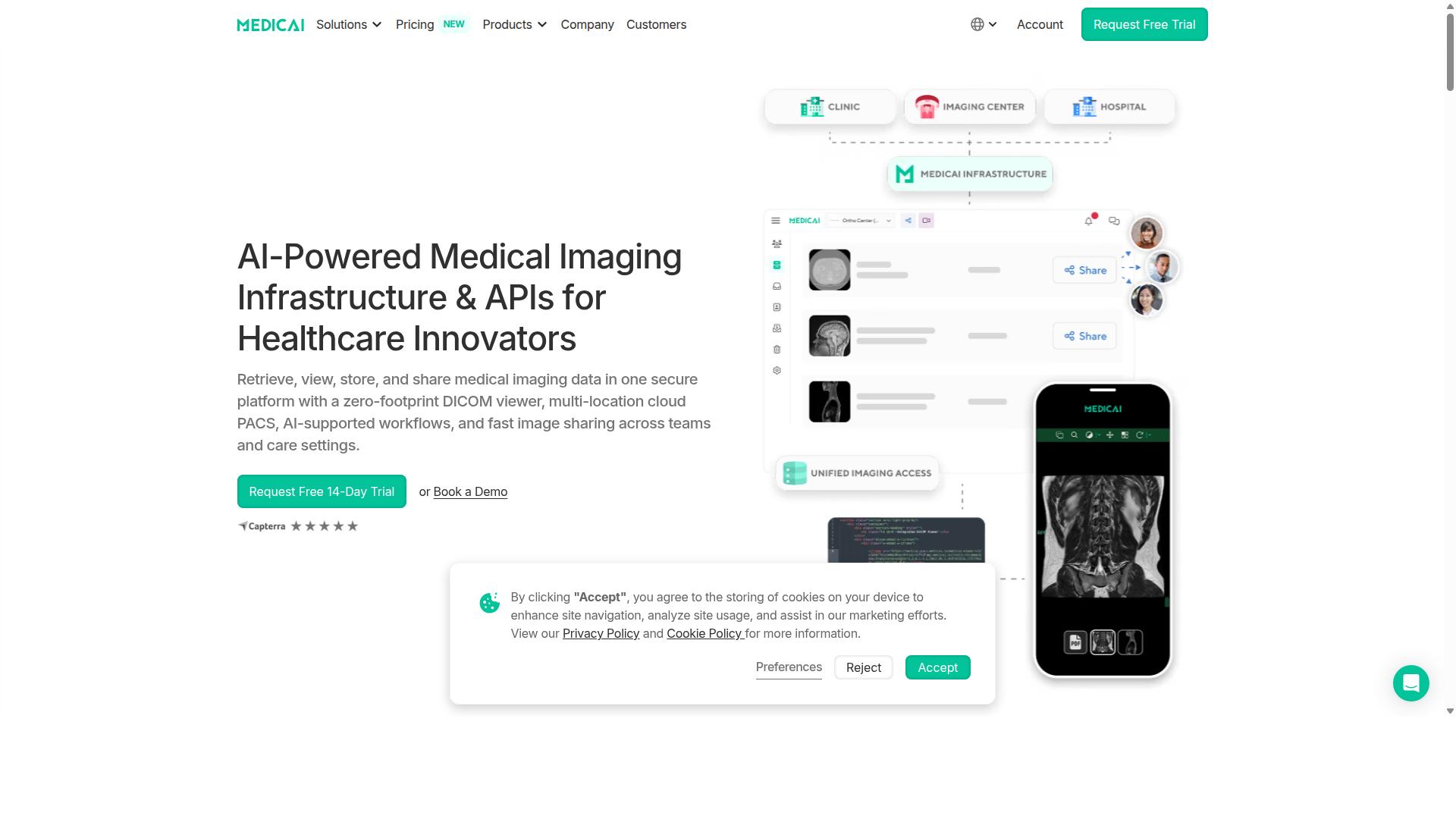
Medicai is a cloud-based medical imaging platform that provides healthcare providers with integrated storage, viewing, and data exchange capabilities. The platform serves as Imaging Infrastructure as a Service for medical facilities seeking unified imaging management.
At its core, Medicai operates as a zero-footprint DICOM viewer that requires no local software installation. This architecture supports medical imaging workflows by eliminating the need for desktop applications or complex setup procedures.
The platform enables healthcare providers to retrieve, view, store, and share medical imaging data within one secure environment. This unified approach addresses common challenges in medical imaging management where data often exists across multiple disconnected systems.
Medicai combines multi-location cloud PACS capabilities with AI-supported workflows to enhance imaging operations. The platform facilitates fast image sharing across care teams and different healthcare settings, supporting collaborative patient care.
As a VC-backed healthcare startup, Medicai focuses on modernizing medical imaging workflows through improved interoperability standards. The platform supports structured data integration by maintaining compatibility with established medical imaging formats and communication protocols.
Why Medicai Excels at Structured Data Integration
The platform achieves structured data integration through standardized protocols that normalize imaging metadata and clinical reports into consistent formats.
Healthcare organizations face challenges when radiology systems and electronic health records use incompatible data structures. Structured data integration resolves these issues by converting raw imaging files and narrative reports into machine-readable elements that support clinical decision support.
Medicai applies HL7, FHIR, and DICOM standards to create semantic interoperability across systems. These healthcare standards translate imaging metadata, radiology reports, and patient data into unified formats that different software applications can process without manual intervention.
DICOM handles medical imaging files from PACS systems while HL7 manages clinical messaging between departments. FHIR extends this capability by providing modern APIs that enable real-time clinical data exchange between radiology information systems and electronic health records.
Data harmonization workflows transform unstructured imaging reports into structured elements through automated mapping processes. These workflows identify key data points in radiology reports and convert free-text descriptions into standardized clinical terminology using established medical ontology frameworks.
Ontology mapping connects radiology-specific terms with broader clinical terminology standards such as SNOMED CT and LOINC codes. This process ensures that findings documented in imaging studies align with diagnostic codes used throughout the medical records system.
Healthcare interoperability improves when radiology workflow data flows seamlessly into EHR systems through structured formats. Clinical staff gain access to imaging results that integrate directly with patient histories and lab values for comprehensive care coordination.
Data normalization occurs at multiple stages throughout the medical data pipeline. Incoming imaging metadata receives validation checks while clinical reports undergo parsing algorithms that extract structured elements from narrative content.
Imaging informatics benefits from these standardization efforts because downstream applications can query and analyze data without format conversion. Research teams and quality improvement initiatives gain reliable access to comparable datasets across different imaging modalities and time periods.
Healthcare APIs built on FHIR specifications allow external systems to request specific data elements from the integrated platform. This capability supports data aggregation across multiple facilities while maintaining consistent structure and terminology standards.
Data governance frameworks ensure that transformed clinical data maintains accuracy and traceability throughout the integration process. Audit trails track each data transformation step from original imaging source to final structured format in the medical records system.
Key Features Supporting Structured Data Integration
Three core features form the backbone of Medicai's structured data integration capabilities.
These elements work together to convert raw imaging data into standardized formats that support clinical decision support and long-term data governance across healthcare systems.
Structured reporting transforms free-text findings into coded elements, while API transactions handle the continuous flow of information between imaging systems and hospital networks.
This architecture supports the 1M+ studies processed each year and the 2M+ imaging studies already uploaded to the platform.
Structured Reporting for Radiology
Structured reporting converts free-text radiology findings into coded, searchable data elements.
The process begins when radiologists complete their impressions, which are then mapped to SNOMED CT and LOINC terminology through automated ontology mapping. This ensures each report section receives consistent clinical codes that downstream systems recognize.
Standardized reports become immediately usable for analytics platforms and clinical decision support tools. The 300k+ visualizations generated in the past year demonstrate how these structured elements enable faster interpretation across different care settings.
By replacing narrative text with coded terms, radiology departments achieve semantic interoperability that supports both immediate clinical workflows and long-term data aggregation requirements.
API Transactions and Integrations
Medicai processes over 50 million API transactions annually, enabling real-time data transformation between imaging systems and hospital information systems.
The API architecture supports HL7 and FHIR message exchange through dedicated endpoints that handle imaging metadata ingestion, report delivery, and patient data synchronization across different healthcare environments.
Payload structures for radiology information system integration follow standard healthcare protocols, ensuring compatibility with existing PACS and EHR systems. This infrastructure supports data harmonization across the 70 clinics and hospitals currently using the platform.
The consistent use of structured formats throughout these transactions maintains data integrity while enabling the 10,000+ active doctors on the platform to access normalized patient information regardless of their originating systems.
Pricing and Plans
Medicai offers tiered monthly subscriptions that scale storage and connectivity based on organizational needs. Organizations handling structured data integration require predictable costs that match their data volume and interoperability requirements.
The Starter plan provides 500 GB of cloud storage and unlimited user accounts for $249 per month. This tier suits smaller practices that need basic medical imaging storage without connecting external systems.
Teams working with structured data integration can store radiology reports, imaging metadata, and clinical data exchange files within the included capacity. The unlimited user accounts let entire departments access standardized patient data without additional per-user fees.
The Standard plan expands capacity to 2 TB of cloud storage and includes one connected location for $749 per month. This option supports growing organizations that require EHR interoperability and PACS connectivity.
Facilities managing DICOM and HL7 data benefit from the included location connection. The increased storage handles larger volumes of imaging informatics files while maintaining data harmonization across systems.
Organizations with complex workflows can choose Enterprise pricing. Custom cloud storage and multiple connected locations accommodate extensive medical data pipelines and healthcare interoperability needs.
Yearly billing provides 15 percent savings across all tiers. The Starter plan costs $209 monthly when paid annually, while the Standard plan reduces to $639 monthly with yearly commitment.
A 14-day trial of Starter plan features allows organizations to test structured data integration capabilities. Per-study pricing options exist for enterprise customers with specific usage patterns.
Trust Signals
Compliance certifications and transaction volume metrics establish Medicai's reliability for handling sensitive medical data. Healthcare organizations need partners that demonstrate both technical security and regulatory adherence when managing patient information across systems.
HIPAA and GDPR compliance form the foundation of Medicai's security framework. These certifications ensure patient data protection meets international standards for privacy and security. Additionally, FDA and CEE cleared viewers provide regulatory assurance for clinical use in diagnostic workflows.
Volume metrics further demonstrate platform adoption. Medicai processes 1M+ studies per year while maintaining 1.7M+ studies in storage. These figures indicate consistent reliability across medical facilities handling substantial imaging workloads.
The platform supports 70 clinics and hospitals with 10,000+ active doctors. This network spans institutions that depend on secure data exchange for daily operations. The Microsoft Azure partnership adds enterprise-grade infrastructure backing to these compliance measures.
Security practices extend beyond basic requirements. OWASP guidelines inform platform development, addressing common vulnerabilities in web applications. This approach protects against emerging threats while maintaining data integrity throughout medical imaging workflows.
Who Should Use Medicai
Hospitals, imaging centers, and specialty practices that require seamless imaging data exchange with existing EHR systems represent the primary user base. These organizations need reliable tools to manage clinical data exchange across multiple departments and external partners.
Orthopedics, neurology, oncology, cardiology, and ophthalmology practices benefit most from structured data integration capabilities. Each specialty generates complex imaging studies that must flow consistently into electronic health records for accurate patient care coordination.
Specialty care providers across radiology, ob-gyn, pulmonology, dentistry, and gastroenterology also rely on standardized data exchange. These practices handle diverse imaging modalities that require consistent formatting to support clinical decision making and treatment planning.
Virtual care providers and telemedicine platforms need structured data integration to connect remote consultations with existing medical records. Teleradiology services use these capabilities to deliver imaging interpretations back to referring physicians in standardized formats.
Personal injury lawyers, tumor boards, and clinical trials organizations benefit from consistent data harmonization across multiple sources. Medical education organizations use structured reporting to create teaching files and case collections for training purposes.
Patients access their medical imaging through the Patient Portal, which provides direct viewing of their DICOM studies and radiology reports. This capability supports patient engagement and improves communication between healthcare providers and patients.
Final Verdict
Medicai delivers a compliant, API-driven platform that standardizes imaging data for modern healthcare interoperability requirements.
The platform focuses on structured data integration through established healthcare standards. This approach supports consistent data exchange across clinical environments without creating custom solutions for each connection.
Healthcare organizations gain access to structured medical imaging data that aligns with existing systems. The standardization process helps maintain data quality while supporting clinical workflows that depend on accurate information.
Implementation discussions can begin through direct contact with Medicai representatives. The company maintains offices in both the United States and Romania to serve different regions.
Medicai USA is located at 7901 4th St N, STE 300, St. Petersburg, FL, 33702 with phone support at +1 (832) 220 1035. Medicai Romania operates from 53-55 N Filipescu, 5th Floor, Sector 2, Bucharest, 020961 and can be reached at +40 316 305 875.
Organizations can also reach the sales team through email at [email protected] to discuss specific integration needs and implementation timelines.
Recommended Resources: